By P. Vangerline Kpotoe
MONROVIA, Sept. 30 (LINA) –Education remains under threat for many Liberian girls who continually face steep obstacles to entering and staying in school. Financial instability, unexpected family loss, and limited support systems frequently derail academic journeys, leaving young women years behind their peers.
Seventeen-year-old Mamayan S. Kromah’s experience exemplifies these hurdles. Currently enrolled in the 10th grade, Kromah notes that she should be preparing for graduation in the 12th grade if not for a critical two-year hiatus from her studies.
Kromah explained that she previously lived with an extended family member, assisting with petty trading to help make ends meet.
However, when her guardian could no longer afford her tuition, she was forced to drop out for two years.
Following this difficult period, Kromah moved in with her mother, who passed away shortly afterward. Responsibility for her schooling then fell to her older sister, who stepped in to cover her academic fees and give her a second chance.
Now back in the classroom, Kromah is persevering through the 10th grade. While returning to school has offered her a renewed path forward.
Teenage Pregnancy: One of the Major Obstacle Confronting Girls Education in Liberia
Lydia G. Kornor, an 11th -grade student from the Wein Town Public School, shared that teenage pregnancy forced her to drop out of school to earn a living during her pregnancy.
Lydia, who is from the Kpelleh ethnic group, left Bong County with the hope of completing her secondary education before turning 20 and pursuing higher education to become a registered nurse.
“I left Bong County and came to Monrovia with the little money my mother gave me for my rent. Everything changed when I met a boy who betrayed me after I got pregnant for him,” Kornor lamented.
She explained, with tears rolling down her cheeks, that her boyfriend abandoned her the moment she needed him most. Her only remaining plan was to sell sugar to sustain herself throughout the pregnancy.
Lydia gave birth to twins at the age of 17 and left school for three years and a few months until her twin girls were strong enough. She is currently selling sugar in the Red Light market to support her children and her aging mother, who still lives in Bong County.
Kornor shared that since childhood, she has always had a passion for nursing, but her past situation put her educational plans on hold multiple times. According to her, the free tuition policy announced for all public schools has given her a renewed chance to continue her education.
“I get my children ready for school, hurriedly rush to the market to sell so I can provide food for their lunch bags, and later prepare myself by 12:00 noon to attend the Wein Town Public School afternoon session in Mount Barclay” she cited.
After years of attending a private school, Mayee A. Kemoka’s final year landed her at the Wein Town Public School after financial hardships hit her single mother.
Mayee has an older brother who graduated last year, but following his graduation, her mother’s financial situation deteriorated, forcing Mayee to transfer to a public school this year.
Mayee was previously a student at Revival Temple A.G. School in the Parker Paint community, Paynesville. Her mother paid over 40,000 Liberian Dollars in tuition to keep her at A.G. last year.
She stated that due to a financial crisis, she had to relocate to a government school while her older brother, who graduated last year, has neither entered college nor acquired any vocational skills.
“Things are not like before. My mother’s business has gone down because of the many responsibilities she carries for us. She sells cooked spaghetti, salad, fried plantain, and other food items on the road in the evening,” she told our reporter.
“Because of the economic crisis and how my mother’s finances have declined, she looks worried every time, and it is because of my brother and me,” she added.
“I have to do all the house chores and help my mother prepare her goods before I can get ready for school. I sometimes go on campus hungry and have to walk home most of the time.
According to the National Policy on Girls Education, Poverty within families is prevalent.
Currently, 1.7 million people in Liberia are living in poverty and about 1.3 million are living in extreme poverty. A comprehensive poverty profile study conducted jointly by the Ministry of Planning and Economic Affairs and UNDP.
In 2008 it was estimated that about 63.8 percent of the population of Liberia lives below the national poverty line of US$1.00 per day and close to 48 percent of the population lives in abject poverty (International Monetary Fund, 2008). Incidence of poverty in post- war Liberia has increased significantly.
The level of poverty is 67.7 percent in rural areas and 55 percent in urban settings.
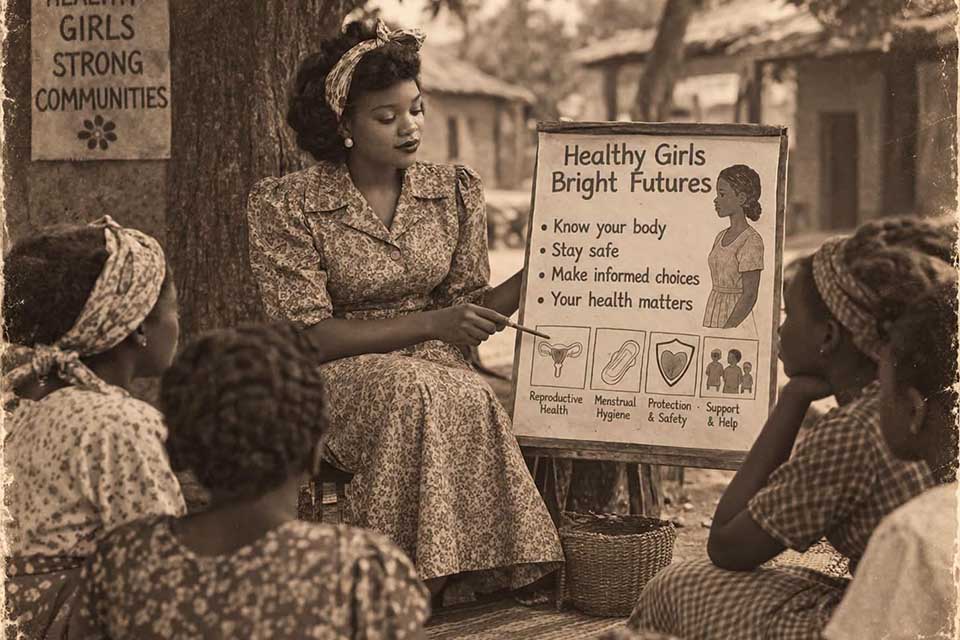
Lack of Hygienic Materials, Another Obstacle to Girl’s Education
Fanta Abraham Bility, from the National Islamic Girls Academy in Monrovia shared the challenges she experiences while in school.
She stressed that her monthly flow distracts her, pointing out that “period poverty”—which forces girls to stay home for 3 to 5 days every month—along with rising sea erosion causing flooding in coastal communities, are major factors that disrupt girls’ education.
The Government must ensure that the declaration of free education is implemented exactly as announced. If parents are told there will be no tuition, registration fees, project fees, teacher appreciation fees or hidden charges, then no public school should be permitted to introduce such charges through another name.
Fracia K. Donzo an instructor of the National Islamic Girls Academy noted that back then when they were small, there was a common saying in school that women should not be found in school; that it is the men who should go to school and take care of the family. But things have changed, and it is a good thing to have a gender-equal society.”
Women should be given their rights to make their own choices as they are on par with the men academically.
According to the Ministry of Education National Policy on girls Education, from the 2012/13 School Census report, girls constitute 47 percent of the student population at the pre-primary level and 44 Percent at the primary level. Enrollment of girls is projected at 40.5 Percent and 37 percent for junior and senior high levels respectively.
Although there have been considerable achievements, the figures are not satisfactory especially at junior and senior secondary levels.
However, more than 400 school-going Liberian girls face imminent displacement if the administration of the More Than Me Academy does not take urgent action.
The court ordered an eviction of the school recently from its Ashum and Front Street building.
The writ ending the school’s tenancy was issued on Tuesday, September 15, 2026 by Assigned Circuit Judge Nelson B. Chineh of the Sixth Judicial Circuit Civil Law Court. It names Matu Kumba Montgomery as the plaintiff, alongside the management of the More Than Me Foundation, the Republic of Liberia through the Ministry of Justice, and the City of Monrovia as defendants.
The court order commands the sheriff to “oust, evict and eject” the occupants. It stems from an August 16, 2019, ruling by then-Assigned Circuit Judge Yamie Quiqui Gbeisay Sr., which the writ notes was confirmed by the Supreme Court during its March Term A.D. 2026.
For the Montgomery family, Tuesday marked the conclusion of a prolonged legal battle. Erica Davies, a family spokesperson and daughter of the family property stated that they spent approximately 15 years attempting to reclaim their property.
Davies explained that the land had originally been entrusted to former General Services Agency Director General Mary Broh to oversee. Broh subsequently permitted the More Than Me Academy administration to use the premises, though no written agreement was made ensuring the property would be returned to the owners upon request.
Sylvestine P. Gbessagee, Hilltop’s executive director, maintained that the school occupied the building under the genuine belief that the government had legally allocated it for educational purposes, citing a wall inscription bearing the name of former President Ellen Johnson Sirleaf and a historical date.
The academy’s history traces back to an American charity and a competitive grant. More Than Me launched the tuition-free school for girls in September 2013 after winning a $1 million grant from JPMorgan Chase through a televised, online-voted competition.
However, the institution was severely derailed five years later when a joint investigation by ProPublica and TIME revealed that senior staff member Macintosh Johnson had sexually abused vulnerable students from West Point, and that leadership had failed to prevent the abuse. Founder Katie Meyler subsequently resigned, prompting a multi-agency government investigation and intense public calls for accountability, even as students begged for the academy to stay open.Today, the sudden eviction has left parents in deep distress.
Wilmot Tarpeh, a Clara Town resident and father of two students at the academy, shared his frustration after having already paid 50% of his children’s tuition. With a total cost of US$300 for the academic year, he stated that he has no remaining funds to enroll them elsewhere.
“This is my children’s first year in this school, and I had no idea that the school was going to be evicted soon. This is really frustrating, and I’m calling on the government to intervene so that our children aren’t forced out of school,” Tarpeh said.
He noted that his daughter Joy is in the ninth grade, while his other daughter, Mariam, is in the sixth grade.
UNICEF’s recent flagship initiative supporting girls’ education and adolescent empowerment in Liberia is the joint 5-year program titled: “Nurture, Empower and Protect (NEP): Harnessing the Full Potential of Adolescent Girls in Liberia.”
Experts say the project is backed by a $7 million grant from the Government of Ireland, this joint program brings together UNICEF Liberia, UNFPA, and multiple Liberian government ministries (including Education, Health, and Gender).
Designed to empower over 107,000 adolescent girls. Focused heavily in Montserrado Grand Gedeh and Rivercess Counties.
Citing alarming statistics from a survey conducted by the Ministry of Education and Gender, President Joseph N. Boakai expressed concern over the approximately 85,000 out-of-school children in the country, terming it “unacceptable” and emphasizing the need to halt this trend.
He stressed the significant impact of children’s quality of life on the future of the nation, urging immediate action to address the challenges faced by vulnerable children.
Data from the Ministry of Education’s 2024–2025 report shows that total female enrollment across Liberia’s 15 political subdivisions—spanning early childhood education, primary, junior, and senior high school—amounted to 1,074,631 (one million, seventy-four thousand, six hundred and thirty-one).
Alfred George, Director of the Education Management Information System (EMIS) at the Ministry of Education (MOE), stated that the ministry has completed 96 percent of data collection for both male and female enrollment for the 2025–2026 academic year.
He noted that the complete dataset is expected to be released to the public on October 1, 2026.
The unexpected interruption has permanently altered her educational trajectory—serving as a stark reminder of the urgent need for sustained advocacy, mentorship, and empowerment initiatives to keep girls in school across Liberia.
This story is being supported by the Merck Foundation.